Traditionally, a band’s story begins in a cramped garage or a sweaty rehearsal room.
Hours together.
Shared spaces.
Late-night practices.
SCARVEIL didn’t.
There’s something quietly radical about a group of people who decide to make music together before they’ve ever stood in the same room. No shared amps. No accidental eye contact mid-riff. No arguing over where to get food after practice. Just a shared faith in each other’s instincts, across cities, through screens, with whatever gear happened to be plugged in that evening.
That kind of trust doesn’t come from proximity. It comes from something harder to manufacture.

Before The Band Existed
Some of the most important creative relationships start long before anyone calls them that. They begin in comment sections, in group chats, in the strange little internet communities that form around shared obsessions.
For Aniruddh, two of his bandmates weren’t strangers when the project began.
“I have known 2 of the members,” he says, “from an FB group called Indiandjentposting.”
A Facebook group. Not a label. Not a college. A corner of the internet where people who cared about a very specific kind of music found each other, probably without knowing they were building something that would outlast the algorithm.
This matters more than it might seem. Communities often become collaborations long before they become bands. The group chat is the rehearsal room. The comment thread is the first audition. By the time someone says “let’s actually make something,” the chemistry has already been running quietly in the background for months, sometimes years.
When SCARVEIL’s music eventually reached Aniruddh’s ears, the decision wasn’t complicated.
“It took me one listen,” he says, “to say ‘Yes’.”
That’s not impulsiveness. That’s recognition.
Building Chemistry From Different Cities
Mumbai. Delhi. Pune. Bhopal. SCARVEIL is, geographically speaking, a band that shouldn’t be easy. The members are spread across cities with different time zones, different creative rhythms, different daily lives.
Aniruddh doesn’t dress this up. “It is most definitely a limitation,” he says plainly.
But here’s the thing about limitations: they often become the defining shape of the work. When you can’t be in the same room, you develop other muscles. You learn to communicate more precisely. You become more deliberate about what you’re asking for and why. Distance doesn’t dissolve commitment. It just changes the container.
For SCARVEIL, that container is largely digital. Files sent across cities. Feedback typed into messages at odd hours. The limitation becomes the practice, and the practice becomes the sound.

Writing Without A Rehearsal Room
Traditional band dynamics usually involve a kind of creative hierarchy. Someone brings a riff. Someone arranges it. The band learns it together until it sounds like the band.
SCARVEIL’s process is more fluid, and more generous, than that.
“The skeleton can be provided by anyone,” Aniruddh explains, describing a writing approach built on openness rather than ownership. What follows that skeleton is what makes it interesting: “Everyone else improvising on it.”
This is collaboration functioning at its most trusting. When anyone can start something, and everyone is trusted to build on it without ruining it, the process becomes less about hierarchy and more about faith. You have to believe that the people you’re working with will hear the intention inside an incomplete idea and carry it somewhere better than you could have alone.
That’s not a given. That’s built.

Discord, Earphones, And Songs
There’s a particular image that captures something true about how music gets made now. SCARVEIL working through vocal ideas, as Aniruddh describes, “over a Discord call, with our shitty earphone mics.”
It’s not glamorous. It’s not what anyone pictures when they think about recording sessions. But something real happened in those calls, something that no amount of studio polish can fully replicate: two people listening closely to each other, making something work despite imperfect conditions.
The technology didn’t replace chemistry. It simply became another rehearsal room.
And within that space, specificity mattered. Aniruddh recalls navigating the nuance of particular moments in the music: “If a part needs control and sass…” That kind of language, the vocabulary of feel rather than technique, is how people who understand music talk to each other when the goal is something more than technically correct.
Learning To Sing Differently
There’s a version of artistic growth that looks like expansion: you get bigger, louder, more impressive. And then there’s a quieter version, the one that happens when you start questioning the instincts you always assumed were just part of who you were.
For Aniruddh, the journey inside SCARVEIL has involved both.
“Getting these aspects right,” he reflects, “has been a huge learning curve.”
What’s more telling is where some of that learning pointed. “Not every melody is asking me to strain my voice.” For a vocalist who came up in heavy music, where exertion is often worn as a badge, that’s a meaningful shift in perspective. Restraint isn’t compromise. Sometimes it’s precision.
Growth often begins exactly where comfort ends.
Two Voices, One Story
Some songs work because they’re unified. Everyone singing the same emotional frequency, pointing in the same direction. Others work because of tension, because two things that shouldn’t fit together somehow produce something more honest than either could alone.
SCARVEIL leans toward the second approach. “It is a back and forth,” Aniruddh says of the band’s dynamic vocal storytelling. Within that back and forth, there’s real narrative architecture: “Nikhil singing about the grief,” while Aniruddh describes his own contribution as “Me screaming.”
Grief and screaming. Melody and force. The contrast isn’t decorative. Contrast creates narrative. It lets a song hold more than one emotional truth at the same time, which is usually closer to how those emotions actually feel in real life.
The Longest Song Title
Somewhere along the way, SCARVEIL named a song “I Only Have 2 Friends And I Am 1 Of Them.”
It’s the kind of title that stops you mid-scroll. It’s specific enough to feel like it came from a real place, and bleak enough to be funny in the way that only honest things can be.
“It was a working title,” Aniruddh admits.
And then it wasn’t. Sometimes jokes become identity, not because they’re jokes, but because they accidentally tell the truth. A throwaway title that stuck might say more about a band than a carefully crafted one ever could.
Becoming More Than A Metal Vocalist
Ask Aniruddh about his influences, and the conversation moves quickly away from the genre his band is typically placed inside.
“My ability to sing catchy melodies,” he says, tracing a set of reference points that includes “Ariana Grande,” “KK,” and “Illenium.”
This matters. Influence doesn’t respect genre boundaries, and the most interesting artists usually aren’t looking at the people directly beside them for inspiration. They’re pulling from unexpected places, mixing textures that weren’t designed to go together, trusting that the resulting strangeness will be worth something.
A metal vocalist who studies pop melody is doing something more interesting than most people on either side of that imaginary line would expect.
Why SCARVEIL Doesn’t Want A Genre
When asked about where SCARVEIL sits sonically, Aniruddh’s answer is almost defiant in the best possible way.
“I want people to be very confused,” he says.
He expands on this by describing the role he hopes the band can play for listeners: a “gateway band.” A way in. A door that opens between one kind of music and another, between one version of yourself as a listener and something you didn’t know you were ready for.
The future, genuinely, belongs to artists who refuse easy categorization. Not because categories are bad, but because the most honest creative work rarely fits neatly into them. Confusion, in this context, isn’t a failure of communication. It’s the point.

What Never Changes
Every artist eventually has to answer the question of identity. Not just “what do we sound like?” but “who are we, and how will people know us?”
For SCARVEIL, the answer is built into the question.
“SCARVEIL wants its identity to be based on its unpredictability,” Aniruddh says. And then, almost paradoxically, he adds the one consistent promise underneath all that unpredictability: “Smooth transitions.”
This is more sophisticated than it sounds. Anyone can be unpredictable. The harder task is being unpredictable without losing the listener, taking them somewhere they didn’t expect while making sure they feel safe enough to follow. Smooth transitions aren’t a softening of the chaos. They’re the craft that makes the chaos livable.
Identity isn’t built by repetition. It’s built by intention.
A Band That Became A Family First
Perhaps the most surprising thing about SCARVEIL isn’t that they blur the line between pop, R&B, and metal.
It’s that they prove a band can become a family long before it becomes a place.
The rehearsal room, the stage, the shared physical space that bands are supposed to need: SCARVEIL built everything that matters without any of it. They built trust over Discord calls with shitty earphone mics. They built creative language through files sent between Pune and Delhi and Mumbai and Bhopal. They built a sound from the influences of people who never assumed their reference points had to match.
What they made, before they made a single song together in the same room, was the willingness to listen. That, it turns out, is where every good band actually begins.
Follow SCARVEIL on Instagram
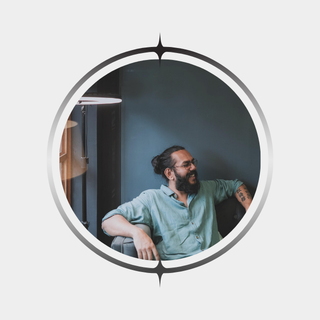
Lubdhak Biswas is a musician, entrepreneur and a tattoo artist based out of Kolkata (India).
He documents underground culture at the crossroads of tattooing and music.
His work focuses on craft, tools, ethics and the real working realities of creative industries.