Science and music are often seen as opposite worlds.
One is built on certainty.
The other survives on uncertainty.
One searches for answers.
The other keeps asking questions.
But perhaps both begin in exactly the same place: curiosity.
Not the polished, institutionalized kind that earns grants and accolades. The raw kind. The kind that makes a person lie awake wondering why a particular chord feels like grief, or why the universe bothers being symmetrical at all. The kind that doesn’t ask permission before pulling someone in two directions at once.
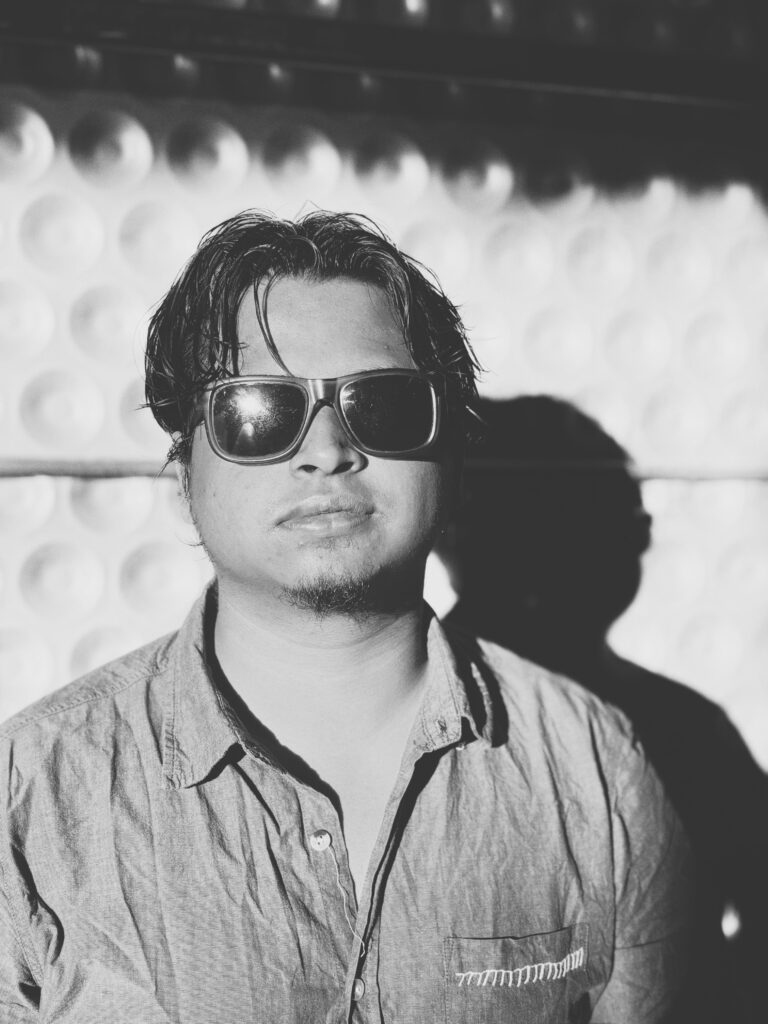
Sounav Sengupta knows that pull well.

Looking For Structure
There is a version of this story that writes itself easily. Physicist by day. Musician by night. Two worlds, one person, clean narrative arc. But that framing misses something essential about how curiosity actually works.
For Sounav, physics and music don’t compete. They converge.
“They both emerge from the same ideation,” he says, “that is, to look for structure, simplicity, and symmetry.”
The instinct that draws a person toward a unifying theory in physics is not so different from the instinct that draws them toward a melody with internal logic. Both are attempts to find coherence in complexity. Both begin with a feeling that something is there, underneath the noise, waiting to be uncovered.
Still, Sounav is careful not to flatten the difference between the two.
“Physics comes from all the rationality of my brain,” he says. “Music comes from the irrational side.”
That distinction matters. It isn’t a contradiction so much as a complete picture. The same mind, accessing itself through different doors.
Why Music Doesn’t Need To Make Sense
Science operates under a particular pressure: to be correct. A hypothesis either holds or it doesn’t. Data confirms or it refutes. There is a standard of verification that structures the entire enterprise.
Music owes nothing to that standard.
“Music is absurd, imperfect, and sometimes meaningless,” Sounav says plainly.
And there is something genuinely freeing in that. Art has historically found its deepest resonance not by resolving tension but by sitting inside it. A song doesn’t need to explain itself to move someone. A chord progression doesn’t need to be logical to feel true. The refusal of certainty isn’t a weakness in music. It is often the source of its power.
For someone trained to seek proof, leaning into that quality requires a particular kind of openness. It means allowing one part of your mind to stop asking “why” long enough for something unexpected to emerge.
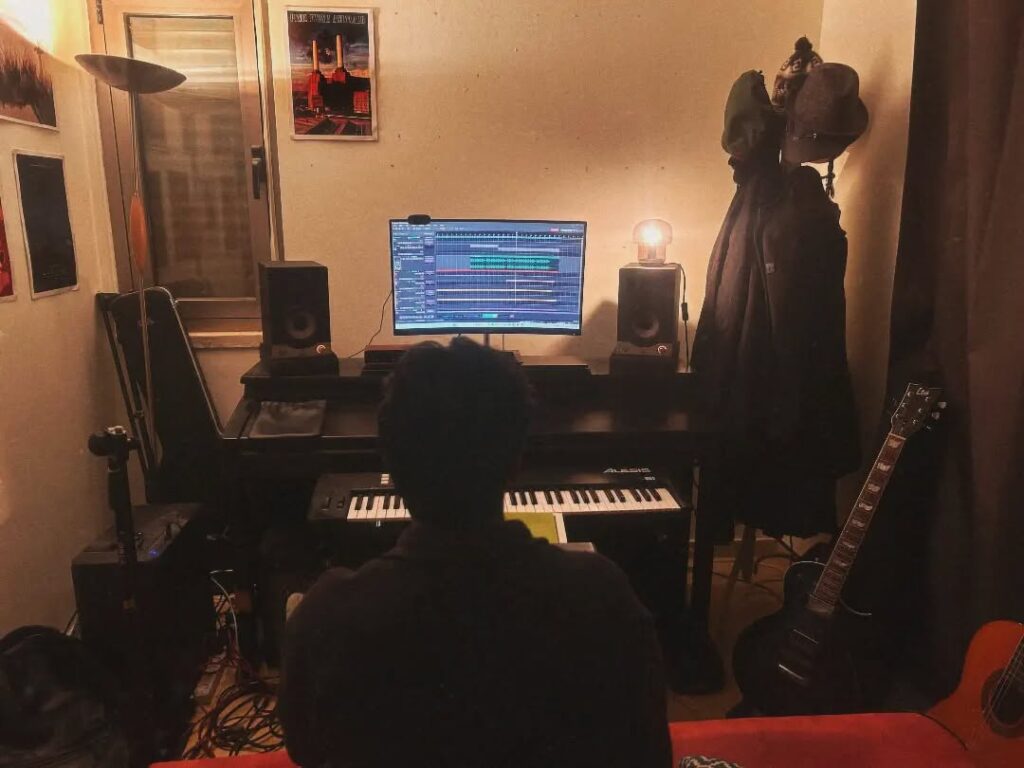
Where Songs Actually Begin
So where does a song start, when you’re also someone who thinks about equations?
Not with theory, it turns out.
“It is an idea that starts the process,” Sounav says. And then, on what follows: “The most pleasurable part is to decorate that idea with a soundscape.”
That word, decorate, is interesting. It suggests that the core of a song arrives already formed, in some essential way, and that everything else, the layers, the textures, the arrangements, is a kind of reverent embellishment. The initial spark doesn’t need to be justified. It just needs to be followed.
This is a creative instinct that transcends discipline. Writers recognize it. Architects recognize it. The idea comes first and the craft builds the house around it. What changes is the vocabulary used to give the idea shape.
Understanding Sound Beyond Music: How Physics Changes What You Hear
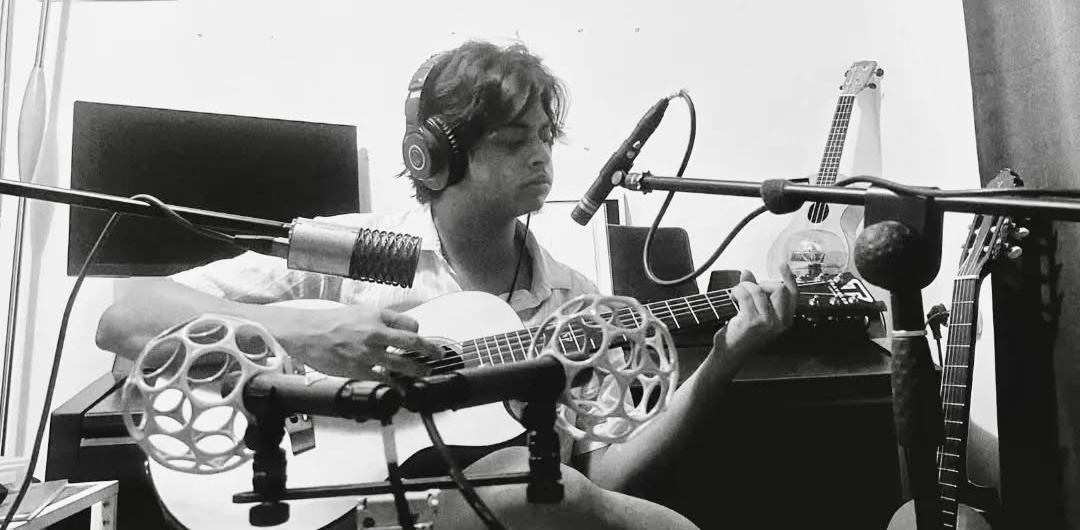
Sounav studied physics. Along the way, he encountered concepts that had direct relevance to the thing he loved: sound. Signal processing. Psychoacoustics. The physics of frequency and the science of how the human brain perceives it.
Most people hear music and feel it. Sounav hears music and understands it at a different resolution.
“Physics helped me understand signals in general,” he says.
The effect was practical, not just theoretical. “I got better at composing and producing.”
This is what knowledge does when it moves across disciplines. It doesn’t change what you feel. It changes what you notice. It hands you a different set of tools for shaping something that already mattered to you, and suddenly you can do things with it that you couldn’t before. The emotional relationship with music stays intact. The technical relationship deepens around it.
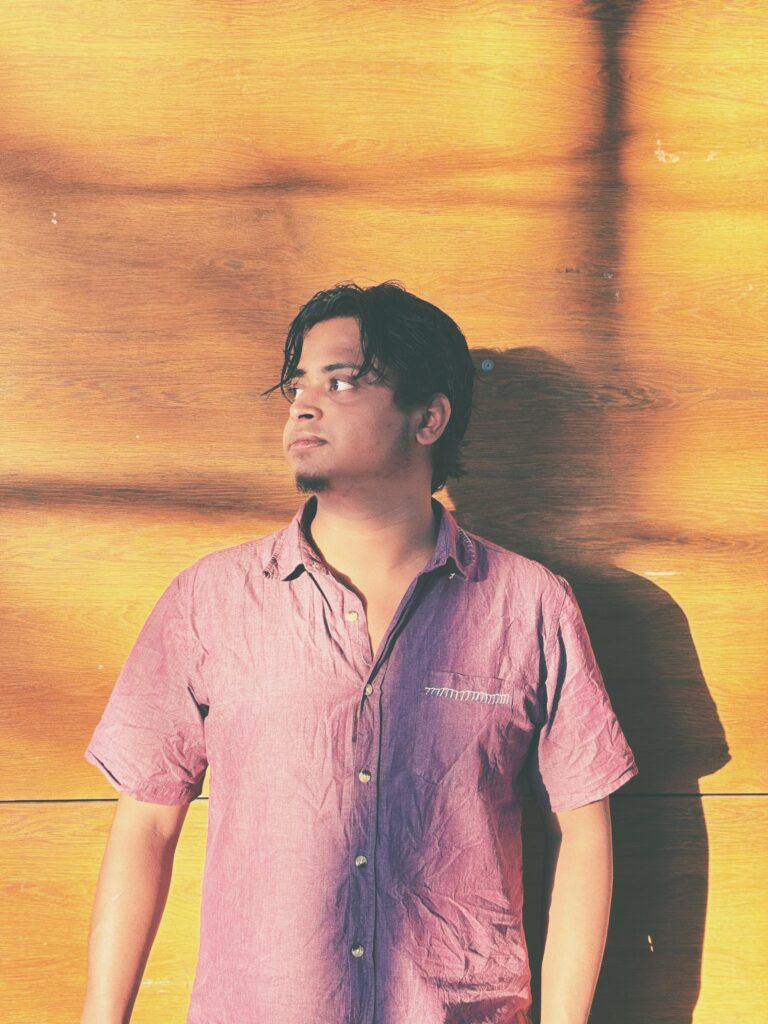
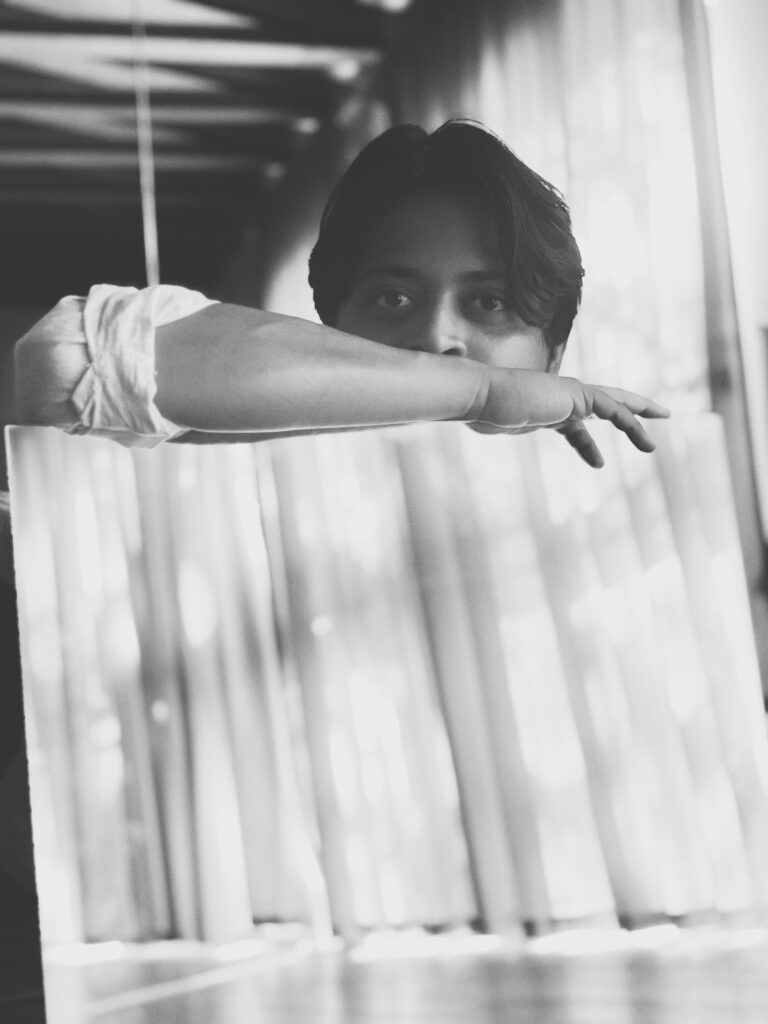
Kolkata, Israel, and Becoming Someone New
Identity, like music, rarely stays in one key.
Sounav grew up in Kolkata, a city with a cultural density that is difficult to overstate. Literature, film, classical music, philosophy, the intellectual and artistic history of Bengal runs deep. He speaks of it with specificity.
“Kolkata holds the roots of my artistic abilities,” he says.
Roots, not limits. The distinction is important. Because Sounav eventually moved, and that movement changed him.
Living and studying in Israel introduced him to something he hadn’t grown up with. An international campus meant proximity to students from across the world, and with them came music he had to learn to hear on its own terms: Persian music, Arabic music, Jewish music. Entire traditions with their own systems of feeling, their own relationships between structure and emotion.
Exposure does something to a person. It doesn’t erase where they came from. It expands the space in which they operate. The roots hold. The branches grow in new directions.
Living Through War
There are experiences that don’t translate easily into creative expression, not immediately, not cleanly. Some things have to be absorbed slowly, processed at a depth that takes time to reach.
Sounav speaks about this with restraint, which itself says something.
“Living through a series of wars has changed my personality drastically,” he says.
He doesn’t elaborate beyond what the experience requires. He doesn’t perform clarity about something that hasn’t yet resolved.
“I am still processing wars,” he says. And then, carefully: “One day it might reflect on my music.”
That sentence carries a kind of patience that is hard-won. The understanding that not every experience becomes art on its own timeline. That some things sit inside a person, accumulating weight, waiting for the right form. The art is not yet visible. That doesn’t mean it isn’t happening.
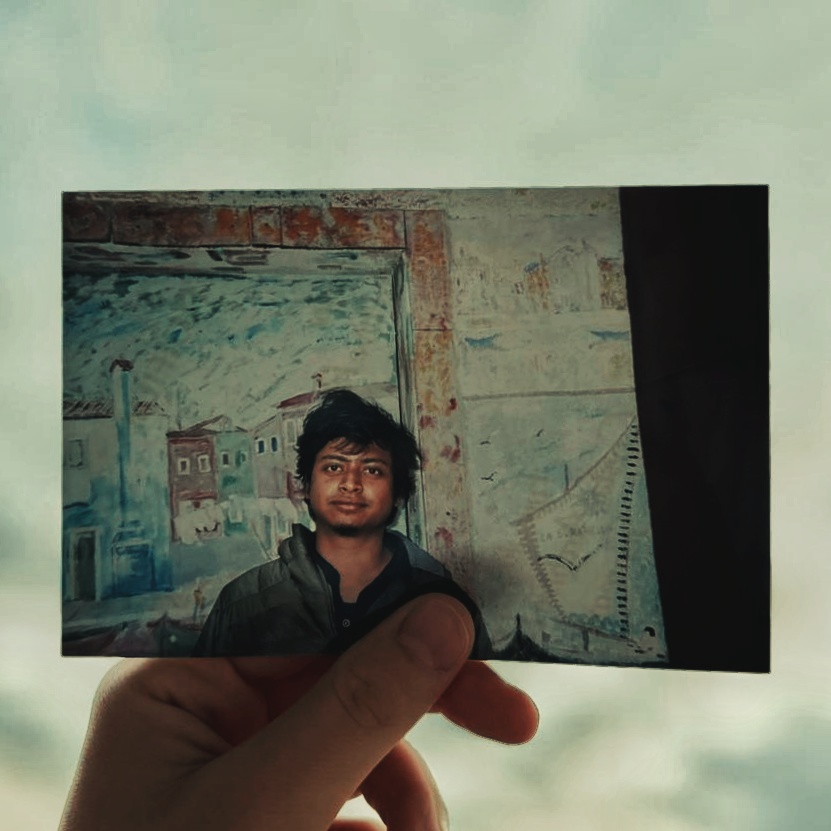
The Sound Keeps Changing
The music Sounav makes now is not the music he has always made.
“I am slowly moving away from conventional rock music,” he says.
What he’s moving toward is harder to name, which is perhaps the point. “Ambient soundscapes.” “Persian/Arabic influences.” A vocabulary that is still being assembled.
This is how artists tend to grow, not by abandoning what they knew, but by finding it insufficient. The sounds that once felt like the only possible expression start to feel like one dialect among many. And so the search continues, wider now, less bounded by genre or geography.
The influences absorbed in Israel, the tonal systems and rhythmic languages of musical traditions he encountered there, are finding their way into his work. Not as imitation. As expansion.
Never Knowing The Destination
There is something almost radical, for a physicist, in this admission:
“I don’t know where I am heading.”
Science tends to reward clarity of direction. The hypothesis, the methodology, the expected outcome. But the creative life, even for someone steeped in scientific thinking, doesn’t always cooperate with that structure. Sometimes the most honest thing a person can say is that they are following something whose destination they cannot yet see.
What Sounav knows is one concrete wish, modest and specific: “I would love to perform in Kolkata.”
To return, with everything he has gathered since leaving. To bring the ambient textures and the Persian inflections and the years of signal processing and psychoacoustics and wartime stillness back to the city where the roots are.
Curiosity, ultimately, is not about knowing where you’re going. It is about trusting that the asking is worth something, regardless.


The Space Between
Perhaps physics and music were never opposites.
One tries to understand the universe.
The other tries to understand what it feels like to live inside it.
Sounav Sengupta occupies the space between those two questions, not as a compromise, and not as a performance of duality, but as someone who seems genuinely convinced that both questions matter. That structure and absurdity can coexist in the same mind. That roots and motion are not in conflict. That not knowing where you are heading is, sometimes, exactly the right place to begin.
The equations and the echoes don’t cancel each other out.
They are, in their own way, the same search.
Follow Sounav Sengupta on Instagram

Lubdhak Biswas is a musician, entrepreneur and a tattoo artist based out of Kolkata (India).
He documents underground culture at the crossroads of tattooing and music.
His work focuses on craft, tools, ethics and the real working realities of creative industries.