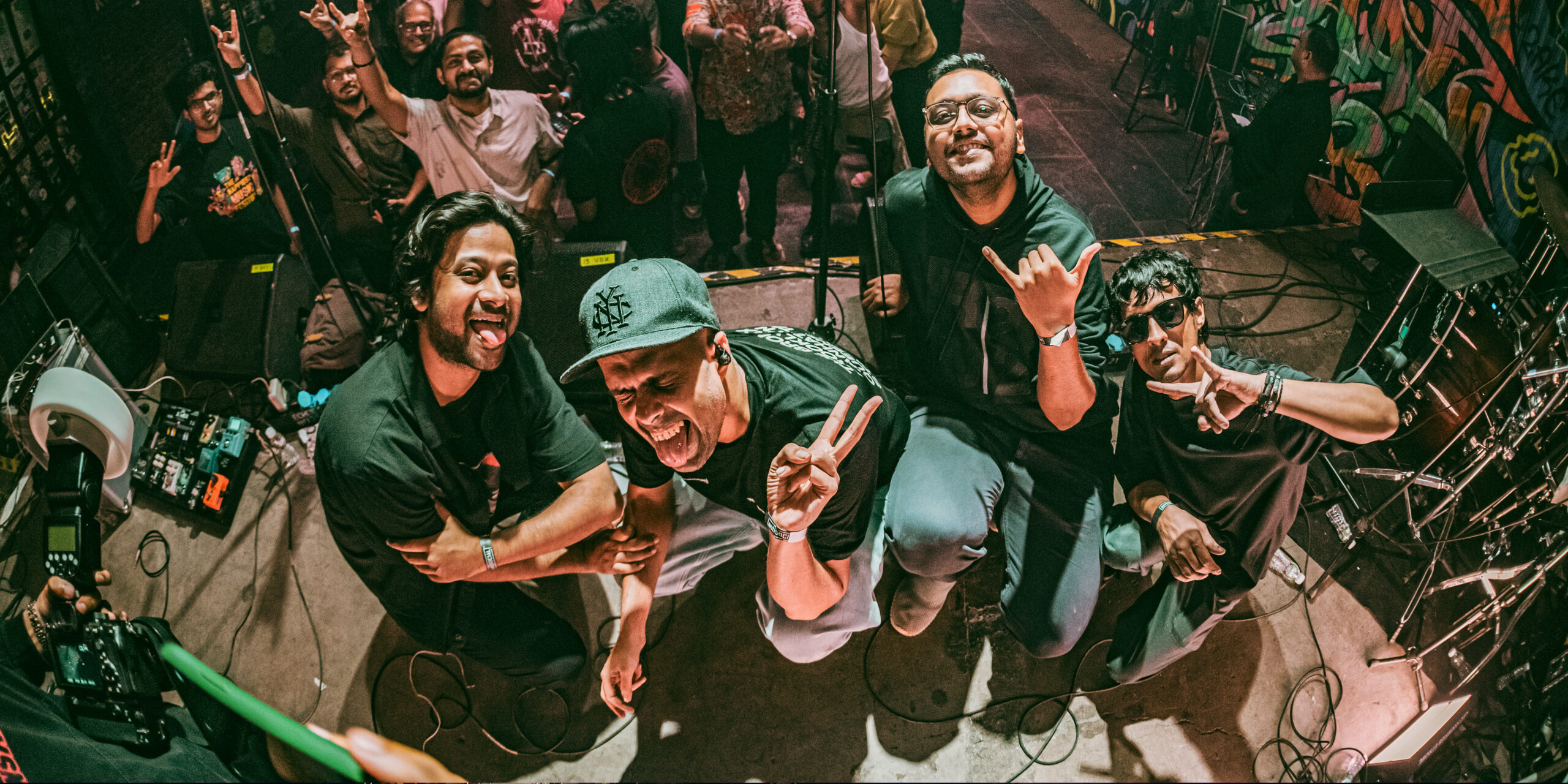
Identity isn’t built alone. The most meaningful creative work emerges through conversations, influences, and communities that shape how ideas evolve. The discourses become the converging point of a new chapter.
The artists who matter most are often those who stay curious, listen deeply, and see themselves as part of something larger than themselves. Artists who draw inspiration from the grand eclectic landscape called Life
Learning Rhythm Before Learning Drums
Sambit Chatterjee’s father, Grammy-nominated tabla maestro Pandit Subhen Chatterjee, did not begin his son’s musical education at a practice pad or a kit. He began it at Rabindra Sarobar Lake in Kolkata.
He would take the young Sambit there and ask him to observe. To pay attention to how the leaves moved with the wind. To notice an ant line following a constant beat in their queue. These were not poetic exercises. They were lessons in something foundational, the idea that rhythm is not something invented by musicians. It already exists. It exists in nature, in movement, in the patterns of living things. Music, then, is not creation from nothing. It is recognition.
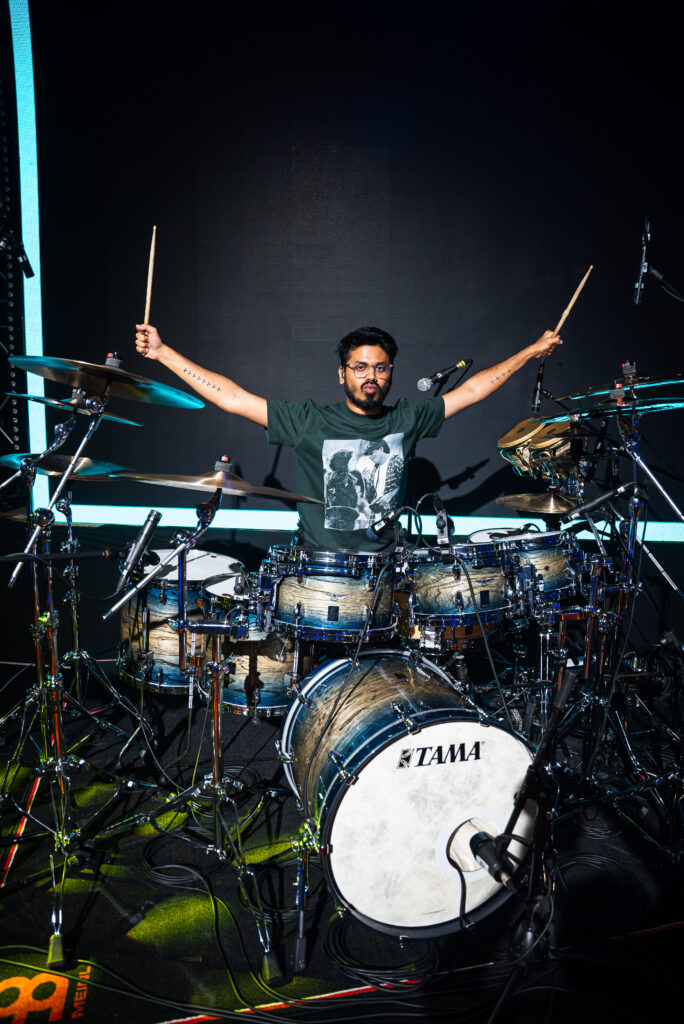
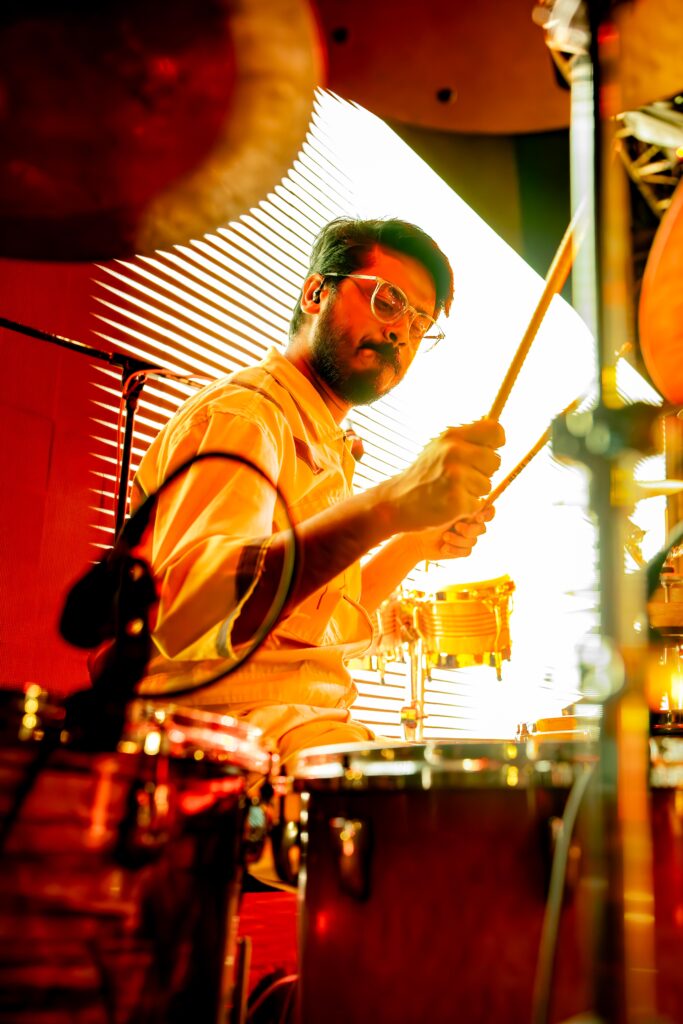
That early observation built in Sambit what he describes as a profound sense of collective consciousness. He started understanding that man is not a solo ego, but a part of a profound consciousness, a part of a larger cycle. Before he learned how to play, he learned how to listen. That order matters.
Growing Up Inside Collective Consciousness
Sambit speaks about his upbringing with a certain ease—not romanticizing it, just describing it clearly.
“I have been brought up in a homogeneous environment.”
Even today, his family visits the local Baba Peer Mazhar during events. The concept of religion, for him, has always been fluid. Identity was never rigid or assigned from a single source. It accumulated.
This is how many people in tightly knit communities experience their early years, not as isolated individuals carving out private selves, but as participants in something already in motion. The neighborhood, the family rituals, the music playing through the walls. Identity does not emerge in isolation. It is assembled collectively, piece by piece, from everything and everyone around you.
Sambit understood this early, and it stayed with him.
The Lesson That Stayed Forever
Of everything Pandit Subhen Chatterjee passed on to his son, one principle proved to be the most enduring.
“Baba always says….no matter what….the song is most important.”
It sounds simple. It is not.
For a drummer, especially a technically accomplished one, this requires consistent humility. The instrument is loud. It is physical. It can easily dominate a room. The temptation to make the drums the center of attention is real, particularly when skill invites it. But Sambit absorbed something that many musicians spend entire careers trying to reach: the instrument is never the point. The music is.
This is not self-erasure. It is a more sophisticated form of self-expression, one that asks the musician to serve something larger than personal display. Sambit took it seriously. When he speaks about his upcoming album, he returns to his father’s words directly:
“You are not important, the music is.” And then, the companion phrase: “Make music which people can hum.”
That is a philosophy, not a technique.

Lineage as Responsibility
Sambit sees himself as a trickle-down effect of his lineage. He extends this outward, describing all of us as individuals and as artists as a culmination of what our previous generation has done.
He uses a specific example to make this concrete. Drummer Nondon Bagchi chose to pursue drumming despite the scarcity of instruments available to him. Because of that choice, an entire generation was inspired. That inspiration moved through the city, through the culture, and eventually through a chain of influence too long to fully trace, it percolated into Sambit’s own music.
This is how culture survives. Not through monuments or institutions alone, but through people who make the decision to carry something forward even when carrying it is difficult. Sambit is aware of his place in that chain. He wants to pass the baton to the next generation of drummers so they can evolve it further. The responsibility is not a burden. It is the point.
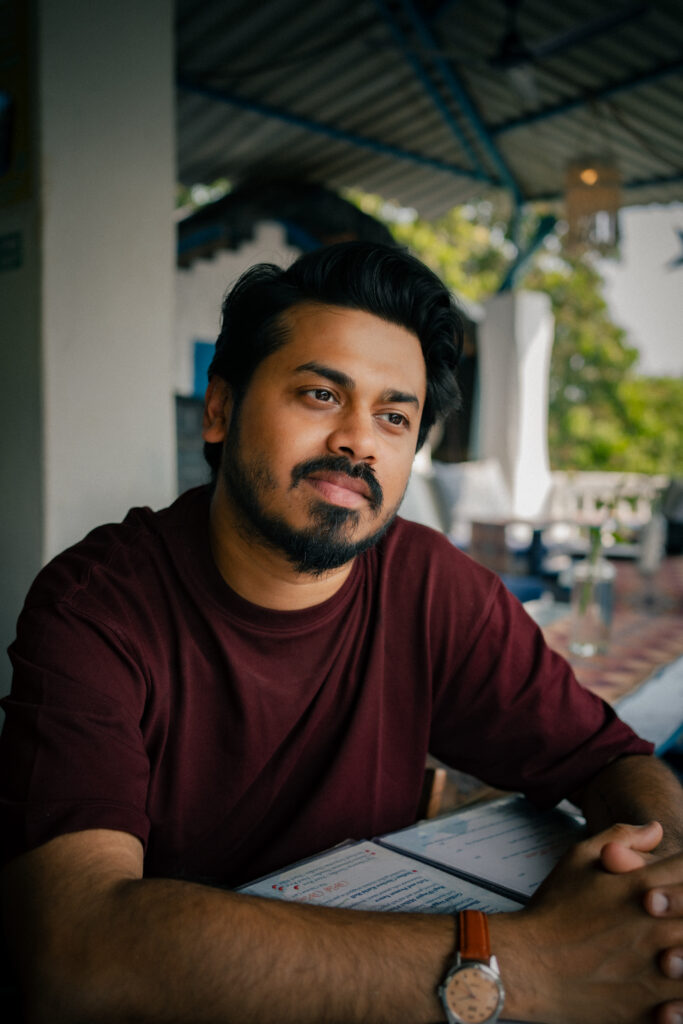

Drumming as Language
There is a common assumption about drummers: that the drums are a release. A place to be loud, physical, expressive in the most primal sense. Catharsis.
Sambit reframes this entirely. Drumming for him is a language more than a catharsis.
The distinction is meaningful. Catharsis is about the person playing. Language is about the conversation between people. A language changes depending on who you are speaking to, what needs to be said, and what the moment requires. It is adaptive, contextual, relational.
This is how Sambit approaches every musical situation he enters.
Different Bands, Different Conversations
That understanding of drumming as language becomes visible when Sambit describes how differently he plays across the various projects he is part of.
“The way that I play with Amyt kaku won’t be the same as I play with Nikita Gandhi and vice versa. The temperament becomes very different with each setup.”
With Amyt Kaku, the dynamics range widely.
“There are peaks where it is almost metal like…the energy I mean and also there are times when it becomes very soft and delicate.” In other settings, the drumming becomes almost caressing. In What Escapes Me with John Paul, it shifts again.
Musicianship, for Sambit, is not a fixed signature repeated across contexts. It is adaptation. It is showing up differently depending on what the music needs, who you are sharing a stage with, and what kind of conversation is happening. The drummer who insists on playing the same way everywhere is not serving the song. He is serving himself.
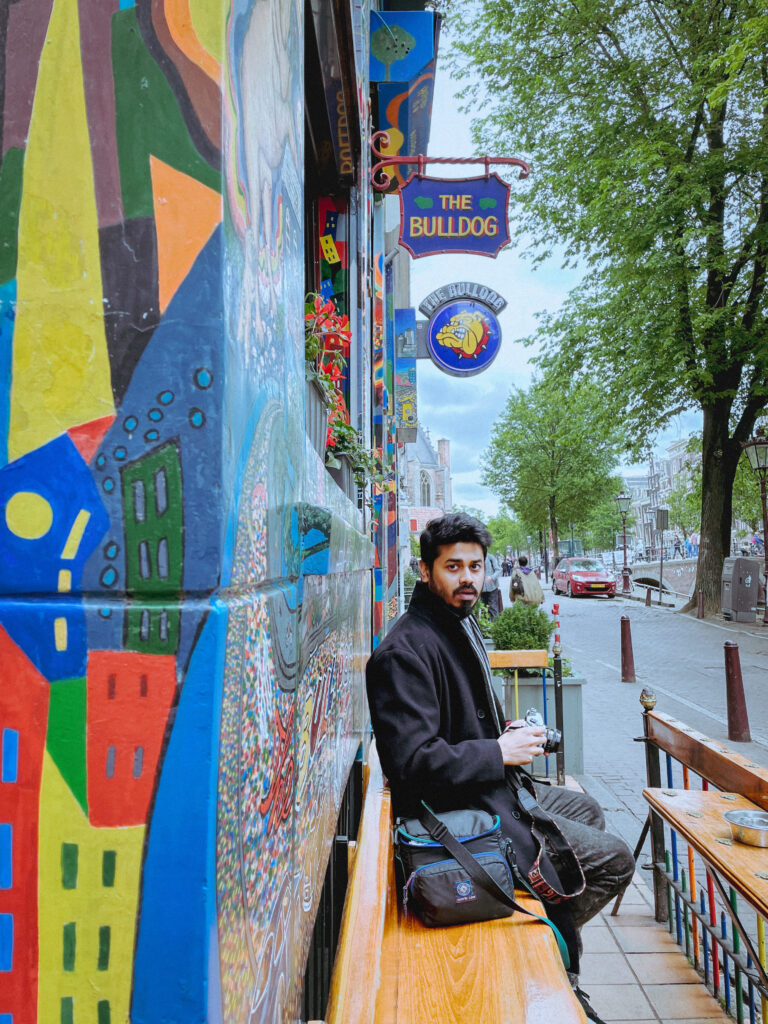
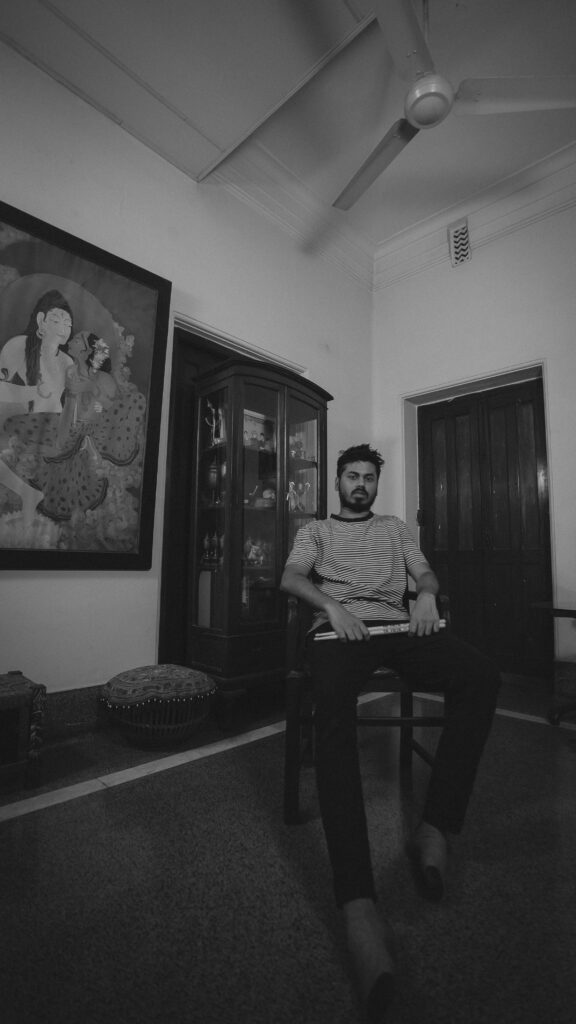
The Special Experience of Playing With His Father
Among all his musical collaborations, one holds a different quality entirely. Playing with Pandit Subhen Chatterjee in Karma, his father’s band, is something Sambit describes with visible warmth and a touch of humor.
“He is my dad, we sit together, eat together, he is also a friend and then he is my bandmate….I can’t explain how lucky and special I feel about this.”
Very few artists get to navigate both family and profession in the same space with the same person. The relationship has every layer simultaneously, parent, friend, teacher, bandmate. That kind of shared life is rare, and Sambit knows it.

Music Through the Eyes of a Father
When Sambit’s wife Chitra became pregnant, something shifted in how he thought about his own work. A childhood memory surfaced. One of his earliest memories of music was the Karma album, his father’s band’s record. It was a special and fun moment. The album was not just music. It was his father, captured in sound.
He wanted to give his son the same thing.
He had been composing throughout his life, traveling the world for fifteen to sixteen years, playing with bands, accumulating songs saved in a single folder. More than forty, some complete, some half-formed. Within them, eleven or twelve told a story together. That became his album.
His father had gifted him albums by Dream Theatre, Fossils, and other artists growing up. That was how Sambit first understood what a music release could mean, not a single track dropped for attention, but a full arc. A story with a beginning, middle, and end.
The album will have eleven tracks. All of them dedicated to his son.
Why His Album Exists
The album is not a career move. It is not a statement of artistic ambition, though the artistry is clearly there. Sambit describes it in much simpler terms. He wanted to gift something to his son that carried the same feeling he had as a child holding his father’s music.
That is the project. An inheritance designed deliberately. Art made not for an audience, but for one specific person who may not even be able to appreciate it yet.
Accountability Instead of Worship
Sambit’s political thinking follows the same pattern as his musical philosophy: collective responsibility over individual hero worship. He points to the way survival conditions shape behavior, the rush before a traffic light turns green, the panic buying, the constant agitation. He traces this back to scarcity.
“That genetic command rises from scarcity.”
The point is not to judge. The point is to understand the mechanism so you can choose differently. Culture shifts when individuals stop waiting for someone else to fix things and start taking accountability for their own role in it.

Knowledge Before Recognition
For the sixteen-year-old and the thirty-five-year-old who might be inspired to pick up drumming after reading his story, Sambit’s first piece of advice is the same: “Be in the pursuit of knowledge.”
Learning, he says, is paramount regardless of everything else. Self-teaching can take you somewhere, but only so far. If excellence is the goal, there needs to be a system, a learning curve, a genuine commitment to understanding the craft deeply.
He draws the parallel to literature. To create something of your own, you first have to go through the works of masters, understand them, learn them. The compendium of that learning stores itself as a bank you draw from for the rest of your life. There are no shortcuts around this.
The Problem With Social Media Aspirations
For the younger reader, Sambit is direct.
“Don’t be blinded by IG followers or the clout. Focus every ounce of energy into getting better. That should be your only priority.”
Attention and mastery are not the same thing. The mistake many young musicians make is measuring their progress by visibility rather than by actual skill. Followers are a reflection of many things, timing, algorithm, luck, aesthetics. They are not a measure of depth.
Getting better is the only work that compounds reliably.
Advice to Different Generations
For someone in their mid-thirties considering a shift into music professionally, Sambit does not offer comfortable reassurances. He is pragmatic. Making money should be the immediate priority. Sustain yourself financially first. Pursue music on the side. Get better. Build the skill. Then, when it becomes a real earning source, make the move.
He puts it plainly. “Positive is for the privileged, the reality is for the real people.”
This is not cynicism. It is the kind of respect that takes someone seriously enough to tell them the truth rather than the version that sounds good in a caption. Practicality and passion are not opposites. They coexist in every sustainable creative life.
What Music Ultimately Means
When Sambit circles back to what music actually is, he lands in the same place he started.
“Music is a language.”
Not a performance. Not a career. Not a platform. A language, a system of communication that requires learning, context, relationship, and the constant discipline of serving the conversation rather than dominating it.
Everything in how Sambit Chatterjee talks about his craft returns to this. The observation at the lake. His father’s directive to serve the song. The adaptability across different bands and collaborators. The album made for his son. All of it is communication. All of it is directed outward.
Maybe the most powerful thing Sambit Chatterjee inherited from his father was not drumming.
It was the understanding that art becomes meaningful when it stops being about the artist alone. The song is more important. That principle does not diminish the musician. It transforms what the music can do, and who it can reach.
Follow Sambit on Instagram

Lubdhak Biswas is a musician, entrepreneur and a tattoo artist based out of Kolkata (India).
He documents underground culture at the crossroads of tattooing and music.
His work focuses on craft, tools, ethics and the real working realities of creative industries.