People meet a design at the end of its life. A poster on a wall. A feed post. A ticket link in a group chat. By the time a design reaches you, every decision behind it has already been made, and none of them are visible.
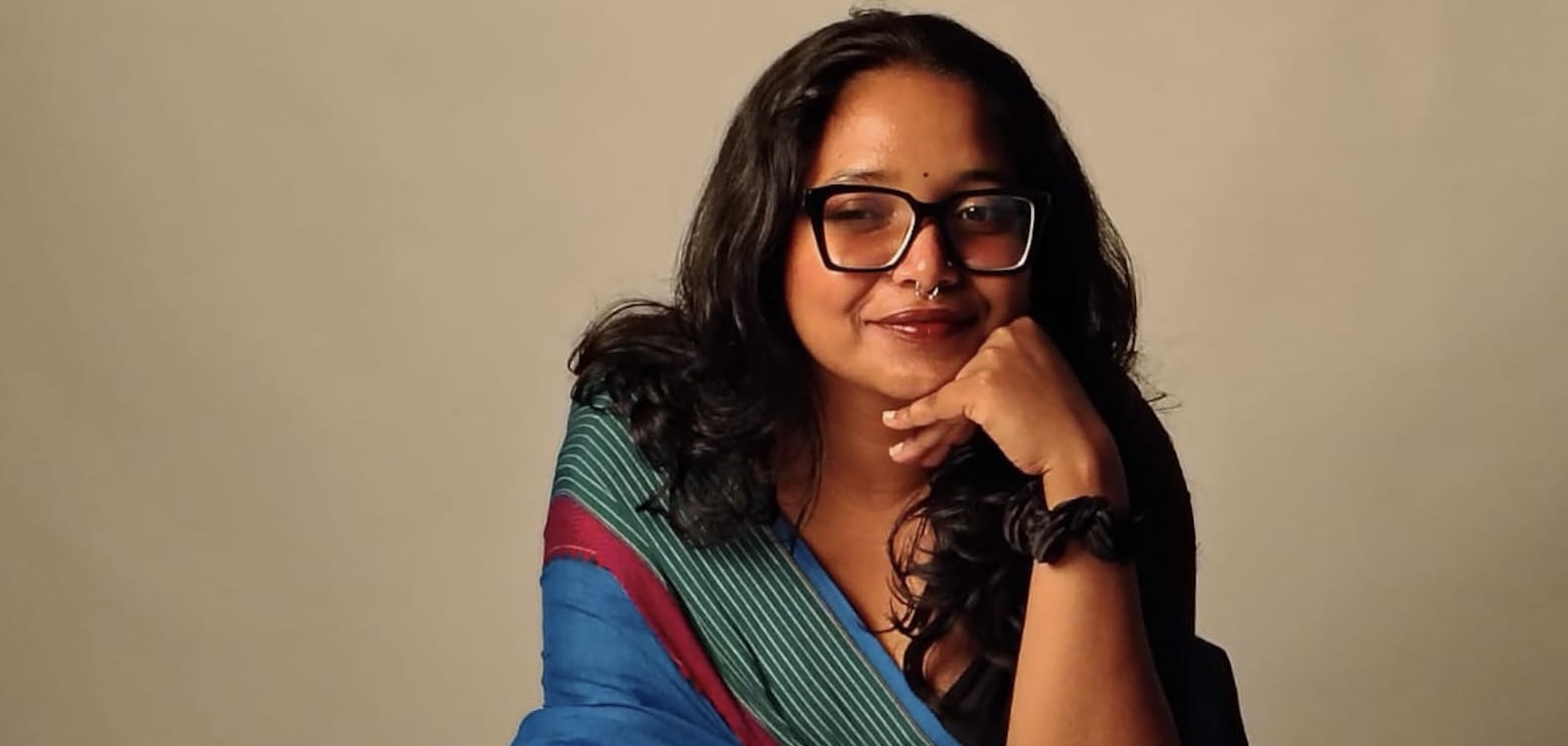
Debosrita Pattanayak spends most of her time inside those decisions. She is a Kolkata-based visual and product designer with a background in Fashion Communication from NIFT Kolkata. Her practice moves across branding, typography, UI/UX, photography, and publication design. At Moonstone, an independent cultural platform, her work has grown well past the design desk. She now handles PR, outreach, talent, sponsors, and even videography.
On paper, that reads like several jobs. In conversation, it sounds more like one long question she keeps asking from different angles: why does this thing need to exist, and who is it really for?
“I think I approach design through context first. I’m usually more interested in understanding why something needs to exist, who it is speaking to and what kind of conversation it is entering before I think about how it should look.”
That order matters. Looks come last. Everything else comes first.
Context Before Colour
There is a version of design that starts with taste. Pick a typeface you love, find a palette that feels current, make it pretty, ship it. Debosrita works the other way around. Before she touches the visual layer, she wants to understand the world the work is walking into.
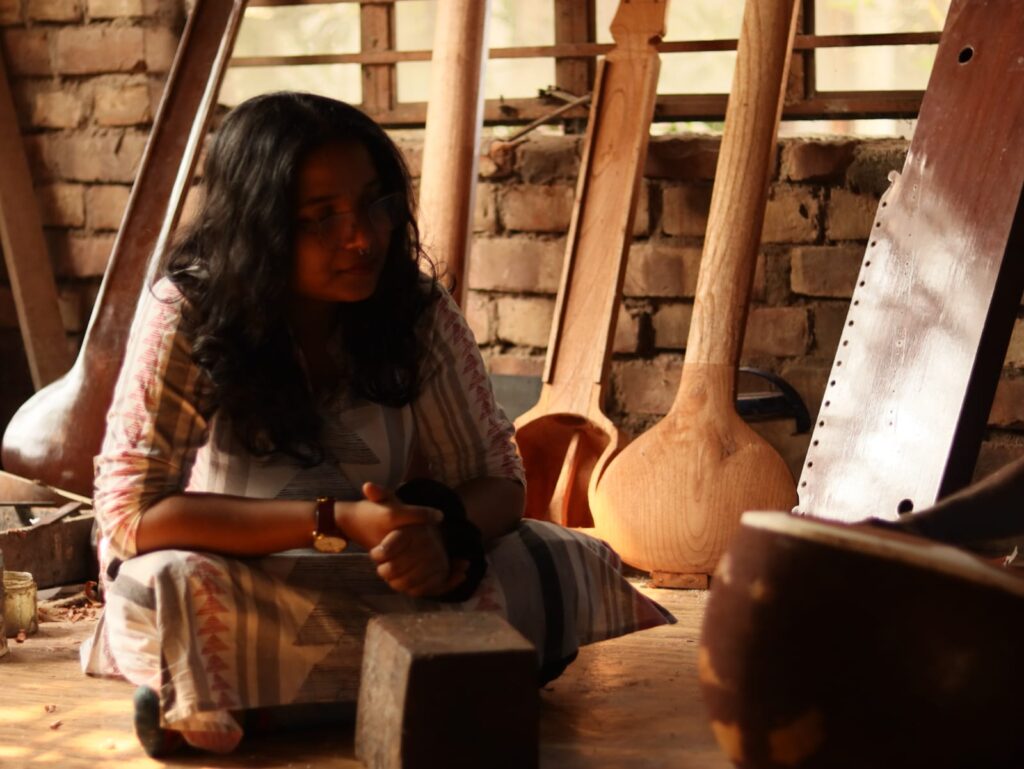
For her, a design never floats free of its surroundings. The people it reaches, the politics around it, and the culture it lands in all shape what it should become.
“I don’t see design as something that exists in isolation. The visual language, the typography, the format, even the way something is distributed can change depending on the people, politics and culture around it. I like working in that space where design becomes a way of thinking, researching and communicating, rather than just making something look good.”
That last line is the key to almost everything else she says. Making something look good is the easy part. Making something that actually fits its moment, its audience, and its purpose takes research, listening, and a willingness to sit with questions before reaching for answers.
It is a quieter way of working. It is also, in a world full of polished surfaces with nothing underneath, a far more honest one.
Let the Idea Pick the Form
Ask Debosrita which medium she prefers and you will not get a neat answer. She does not have a favorite. She has a process for letting each idea tell her what it needs.
“I don’t have a fixed preference for one format because different ideas need different ways of being experienced.”
The phrase “being experienced” is doing a lot of work there. She is not asking which format she is best at, or which one will look most impressive in a portfolio. She is asking how a person will meet the idea, and what kind of encounter would serve it best.
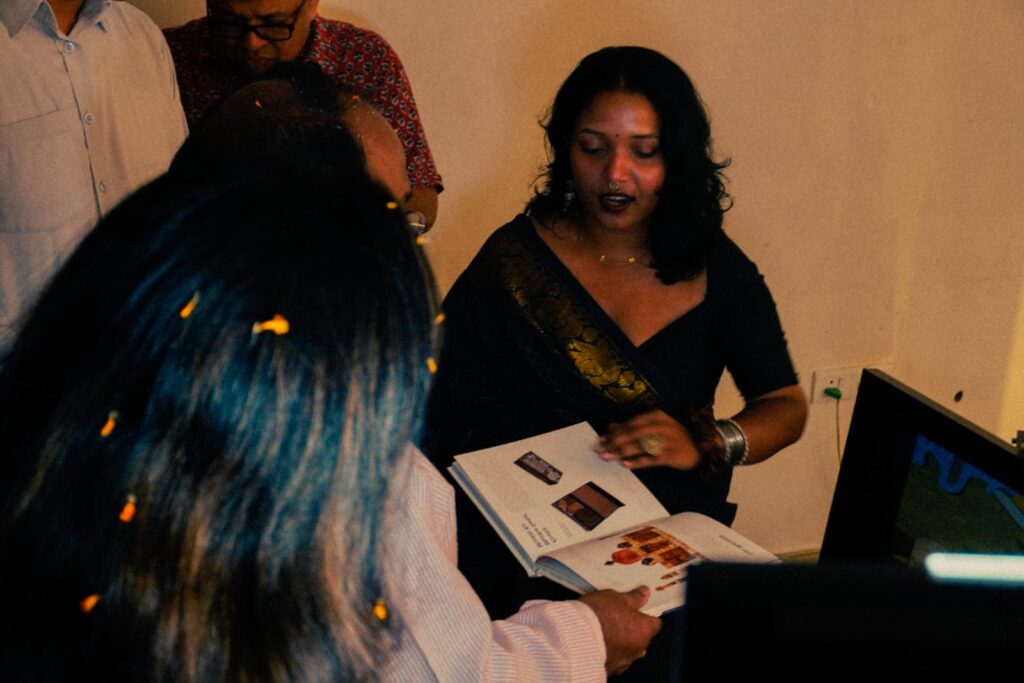
“Sometimes a poster is enough. Sometimes an editorial format gives an idea more room to breathe. Sometimes an interface makes more sense because the audience needs to interact with the information. Photography can also communicate something that typography or graphic design cannot.”
A poster is a glance. An editorial spread is a slow read. An interface is a conversation. A photograph is a feeling that arrives before words do. Each one asks something different of the person on the other side, and Debosrita treats choosing between them as a design decision in its own right.
This is why her practice spans so many disciplines without feeling scattered. The range is not restlessness. It is responsiveness.
Politics Lives in the Process
Plenty of designers make work about political subjects. Fewer ask whether the way they made it matches what it claims to stand for. Debosrita is interested in that second, harder question.
“Politics in design is often present in the process. It affects who gets represented, whose perspective gets prioritised, what language I use and who I imagine as the audience.”
Read that list again slowly. Representation. Perspective. Language. Audience. None of these show up as a slogan on a poster. They show up in the hundred small choices made before the poster exists: whose face is in the photograph, which words get used, who the designer quietly pictures when they imagine someone reading it.
She is also honest about the trap that catches a lot of well-meaning work.
“I also think about accessibility and context. A design can talk about an important political subject while still excluding the people it is supposedly speaking for. I try to question those contradictions in my own work.”
There is no self-congratulation in that answer. She does not claim to have solved the contradiction. She says she tries to question it, in her own work first. That kind of self-scrutiny is rare, and it is what keeps political design from turning into political decoration.
Underneath all of it sits a bigger concern.
“I’m interested in the relationship between design and power. Who gets to speak, who gets seen, who gets left out and who gets to decide what a cultural space looks like.”
That final clause points straight toward Moonstone, and toward the work that has come to define her most.
The Invisible Work of a Cultural Space
Debosrita started at Moonstone designing for events. Over time, her role stretched to cover PR, outreach, talent, sponsors, and videography. Moving between all of those jobs taught her something that no single one of them could have.
“It has taught me that a cultural space is built through a lot of invisible work.”
Anyone who has walked into a great gig, a packed showcase, or a room that just felt right has benefited from that invisible work without seeing it. The poster is what you notice. Everything else is what makes the night happen.
“Designing the poster is one part of an event. You then have to think about who performs, how you communicate with them, how you reach an audience, how you work with partners, how the venue functions and what people experience when they walk through the door.”
That last moment, the walk through the door, is where all the separate decisions finally meet. The lineup, the messaging, the partnerships, the space itself: they stop being individual tasks and become a single feeling in the body of the person arriving.
“Moving between these roles has also made me understand how interconnected they are. The atmosphere eventually becomes part of the identity of the space.”
This is the shift at the center of her practice right now. A designer trained to produce things has started thinking in terms of experiences. The output is no longer a file. It is a room full of people and the way they feel inside it.
“I’ve started thinking less about individual outputs and more about how all these decisions come together to create an experience.”
What Freedom Does to a Curious Mind
Debosrita has said before that not having a strict scope of work at Moonstone is what makes it feel like her own. When she explains what that freedom actually changes, the answer is simple: it keeps her thinking.
“I think I become more curious when I’m given that freedom. If my role was only to design something, I would probably stop thinking about it once the design was finished. Because I can move across different parts of the process, I end up asking more questions.”
There is something quietly relatable in that. So many of us work inside job descriptions that tell us exactly where our responsibility ends. Hand it off, close the tab, move on. The work gets done, but the curiosity gets switched off at the border of the role.
Without that border, Debosrita follows her questions wherever they lead.
“I might start with a visual identity and then become interested in who we should invite, how we should communicate the event or how we document it. One thing naturally leads to another.”
A visual identity becomes a guest list. A guest list becomes a communication strategy. A communication strategy becomes a camera in her hand at the event itself. One curiosity hands off to the next.
That openness also gives her permission to get things wrong, which is its own kind of gift.
“That freedom also allows me to experiment. I can try something, see what happens and learn from the process without feeling like I have to stay inside a predefined role.”
Try. Watch. Learn. Repeat. It is not a grand creative manifesto. It is just what happens when someone is trusted enough to explore.
Kolkata Is Full. It Just Needs to Find Itself.
Kolkata has never been short on creative people. Musicians, illustrators, photographers, writers, designers, people making strange and brilliant things in bedrooms and small studios across the city. Working at Moonstone gave Debosrita a clearer view of all of it, along with an honest read on what is holding it back.
“Working at Moonstone has made me realise how much is already happening in Kolkata, but how fragmented the scene can be.”
Fragmented is the right word. Scenes form around genres, friend groups, and familiar venues. People stay in their lanes, not out of hostility, but because nobody built a road between them. The real change for Debosrita came from watching those lanes cross.
“The biggest shift for me has come from seeing artists from completely different backgrounds occupy the same space and suddenly there is a conversation between practices that might not have happened otherwise.”
One project in particular sharpened that belief.
“Indieমেট has especially reinforced that for me. Bringing together artists with very different sounds and practices made me think about how much potential there is in creating spaces where people don’t have to fit neatly into one category.”
Not fitting neatly into one category is something a lot of creative people quietly carry like a flaw. Too experimental for one crowd, too accessible for another, too in-between for anyone to book. Debosrita sees that in-betweenness as potential rather than a problem, and she sees the solution as something surprisingly modest.
“I think Kolkata has a lot of interesting creative work happening. Sometimes what is missing is simply a space for those people to find each other.”
Not more talent. Not more hype. Just a place where the people already doing the work can meet.
Unlearning the Poster Maker
Design school gives you skills. It also, often without meaning to, gives you a narrow picture of what those skills are for. Debosrita had to let go of that picture once she stepped outside the classroom.
“I had to unlearn the idea that being a designer means being good at making posters.”
She is clear that her training mattered. It just turned out to be portable in ways she did not expect.
“Fashion Communication gave me a strong foundation in visual language, typography, photography and communication, but working outside that structure made me realise that those skills can move across disciplines.”
The harder unlearning was about output itself. Creative fields reward things you can point at. A finished identity. A printed zine. A launched app. But a lot of meaningful work never produces anything you could frame.
“I also had to let go of the idea that every project needs a clearly defined output. Sometimes the work is research. Sometimes it is organising people. Sometimes it is even just writing an email.”
Just writing an email. There is something almost funny about a designer naming that as part of the craft, and something deeply true about it too. The right email to the right artist at the right time can shape an event more than any visual ever will.
Out of all that unlearning, a new definition has taken shape.
“I’ve started seeing the designer less as someone who produces an object and more as someone who can identify problems, connect different things and build ways of communicating between people.”
Identify. Connect. Build. Those are verbs about relationships, not files. It is a definition wide enough to hold everything she does, from typography to talent booking, without any of it feeling like a detour.
A Room You Don’t Have to Earn
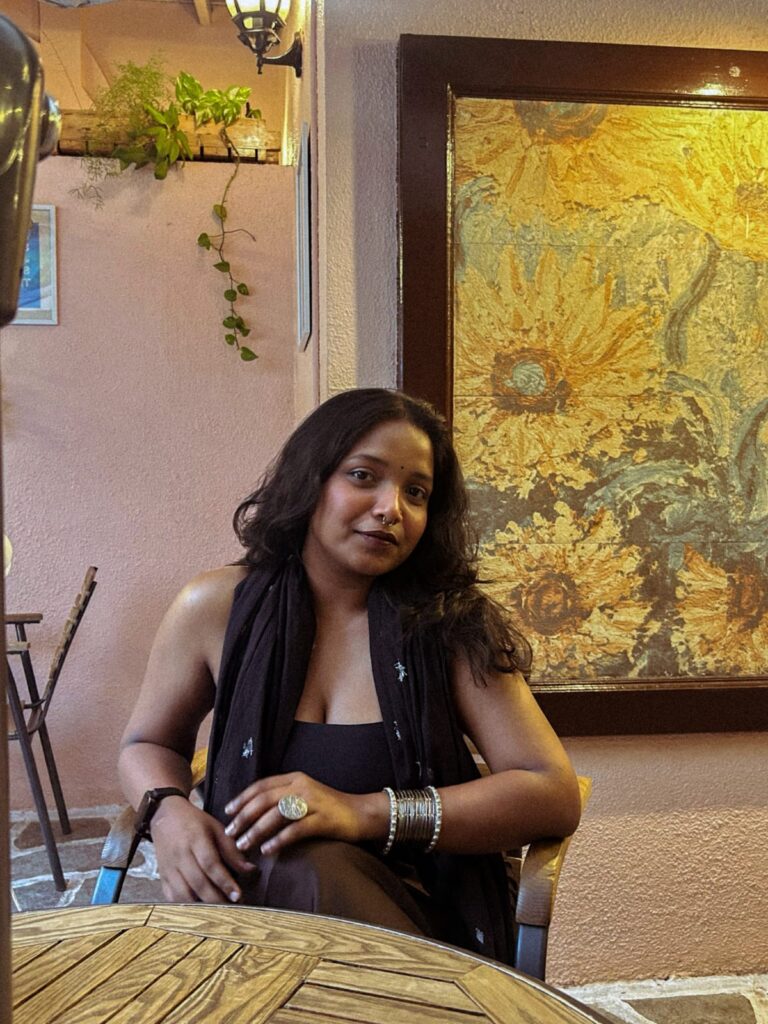
So what is all of this invisible work building toward? When Debosrita describes the cultural space she wants to help create through Moonstone, she starts with a feeling many of us know too well: the quiet pressure of walking into a scene and wondering if you are cool enough, informed enough, or connected enough to be there.
“I want to help build a space where people feel like they can participate without having to prove that they belong there.”
No audition at the door. No unspoken test of taste. Just room to show up as you are.
Beyond belonging, she wants the space to surprise people.
“For me, a good cultural space should allow people to encounter something unexpected. You should be able to come for one artist and leave having discovered three others. You should be able to meet people outside your own creative circle.”
Come for one, leave with three. It is a beautiful measure of success, and a pointed one in an age of algorithms that keep feeding us more of what we already like. Debosrita wants the opposite: a space that gently pulls people out of their bubbles and introduces them to something, and someone, new.
And she wants it to stay rooted in the place it comes from.
“Ultimately, I want to help build something that feels connected to Kolkata and its people, while still being open to experimentation. I think the most interesting cultural spaces are ones that grow with the communities around them.”
The Designer Behind the Door
Go back to that moment when someone walks into an event. They see the lights, hear the sound check, catch the poster they saw online now printed on the wall. They do not see the emails, the outreach, the sponsor calls, the lineup debates, the late-night questions about who this is really for and who might still feel left out.
Debosrita sees all of it. More than that, she has chosen to treat all of it as design.
Her practice is not about any single medium, and it never really was. It is about context first, people always, and the belief that how something is made matters as much as how it looks. It is about a city full of creative people who just need a place to find each other, and a designer who has decided that building that place is the work worth doing.
“I want to help build a space where people feel like they can participate without having to prove that they belong there.”
The poster is just the invitation. The room is the point.
Follow Debosrita on Instagram
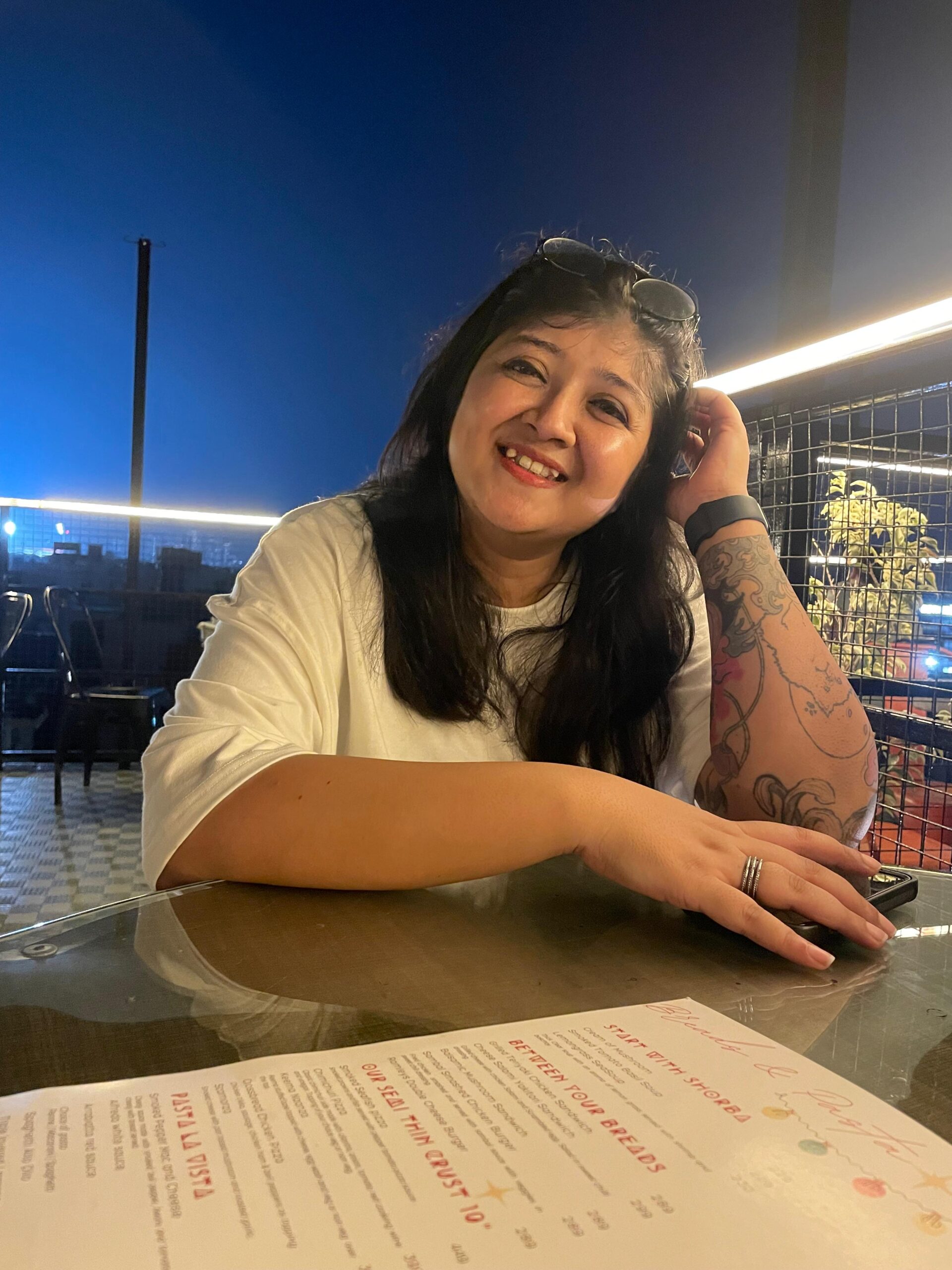
Oeshi B Lyndem is a visual artist, tattoo artist, graphic designer, and entrepreneur with a foundation in graffiti and street culture. Rooted in hands-on craft and making, her practice moves fluidly across illustration, street art, design, and experimental creative processes. With lineage from Shillong—often regarded as India’s rock capital—she carries a distinct cultural influence into her work. At Goofy Owl, she curates and leads the street and hip-hop culture segment through an intuitive, deeply creative, and entrepreneurial lens.